Strengthening Morocco-US Strategic Relations: Asymmetric Threats, Operational Vulnerabilities, and the Architecture of Resilience
The 2026–2036 Defense Roadmap deepens Morocco-US integration to unprecedented levels. This analysis maps eight asymmetric vulnerabilities adversaries will exploit — and the resilience architecture needed to protect the partnership's next decade.
By Umbrax — SecurityNak.com — May 2026
Executive Summary
The Morocco-US partnership is undergoing a qualitative transformation. The 2026–2036 Defense Cooperation Roadmap, the successful integration of Link-16 tactical datalinks, African Lion 2026's unprecedented scale, and advancing discussions on AFRICOM infrastructure at Kenitra Air Base collectively signal a shift from cooperation to operational fusion.
This depth of integration creates proportionate exposure. The partnership now presents a high-value target for adversarial gray-zone operations — from France's competitive intelligence networks and NGO proxies, to Israeli intermediary leverage, to Algerian-Russian amplification dynamics, to Chinese economic alternatives — all designed to fracture the relationship from within rather than confront it directly.
This analysis identifies eight specific vulnerability classes: mutual linguistic-cultural comprehension gaps that adversaries can exploit; intermediary dependencies (including the Moroccan Jewish diaspora and Israeli channels) that create narrative leverage; physical presence risks that cannot be managed through Germany/Japan precedents; dual citizenship jurisdictional gaps; the danger of transplanting Afghanistan-Iraq operational templates to a sovereign ally; NGO and religious operator interference on sensitive Makhzen-managed reforms; benefits distribution patterns that risk replicating France's elite-capture failures across Africa; and a Sahel credibility deficit created by perceived US passivity toward French interference in American diplomatic initiatives.
For each vulnerability, the analysis proposes specific countermeasures — a joint NGO transparency protocol, a Morocco-adapted incident response playbook, US-Israeli separation guidelines, a Marshall Plan-style development compact, and calibrated political party engagement — designed to harden the partnership against the asymmetric threats it will inevitably face over the coming decade.
Critically, this analysis identifies an overlooked strategic resource: the United States' own thirty-five-year operational archive from its continuous military and intelligence presence in Morocco (1942–1977), spanning bases at Kenitra, Nouasseur, Sidi Slimane, and Ben Guerir. These records — capturing Moroccan society, Makhzen dynamics, and civilian-military engagement at a foundational level — offer planning inputs superior to any template borrowed from Germany, Japan, Afghanistan, or Iraq.
The central argument is this: the deeper the integration, the higher the stakes of inattention. Adversaries are already watching. Some are already operating.
Introduction
The Morocco-US strategic partnership is entering a phase of unprecedented operational depth. What began with Morocco's recognition of American independence in 1777 — the first sovereign nation to do so — has evolved through nearly 250 years of pragmatic alignment into a relationship that now touches the most sensitive domains of modern statecraft: joint tactical networks, intelligence fusion, defense industrial cooperation, and coordinated great-power competition across two continents.
The April 2026 signing of the 2026–2036 Defense Cooperation Roadmap at the Pentagon was not a renewal. It was a qualitative leap. Concluded during the 14th session of the Morocco-US Defense Consultative Committee between Minister Delegate Abdellatif Loudiyi and Under Secretary of War Elbridge Colby, it was framed in Colby's own words as the document that "will guide our historic defense relationship for the next decade." The language was deliberate. So was the venue.
The operational translation followed immediately. African Lion 2026, the 22nd iteration of AFRICOM's largest annual exercise, ran from April 20 to May 8 across Morocco, Ghana, Senegal, and Tunisia — over 5,600 personnel from more than 40 nations. Morocco hosted the primary operational hub in Agadir and live-fire exercises at Cap Draa in the Tan-Tan region. More than 30 US-based technology companies embedded alongside military units to test tactical AI systems, advanced command architectures, and deep-strike capabilities. AFRICOM called it "the premier joint, all-domain multinational training event on the continent." That is not diplomatic courtesy. That is doctrinal positioning.
But the most consequential development preceded the exercise. On February 3, 2026, in Agadir, Royal Armed Forces and US personnel successfully tested the Link-16 tactical communication system — a secure, jam-resistant, real-time datalink that was, until recently, reserved for NATO members. Morocco acquired six MIDS-JTRS terminals through a $141.1 million sale approved in 2022. The test's success means something concrete: Moroccan forces now operate on the same encrypted battlefield picture as American and NATO units, sharing enemy positions, radar tracks, and targeting data across air, land, and maritime domains in real time. This is not symbolic interoperability. When a non-NATO ally begins speaking the same digital language as the Alliance's core operational network, the relationship has crossed a threshold. It has moved from cooperation to integration.
These developments — the roadmap, African Lion, Link-16, the drone training center announced for African operators, the AFRICOM discussions around Kenitra — create a trajectory of extraordinary promise. They also create a trajectory of extraordinary exposure.
The deeper the integration, the larger the attack surface. Not for kinetic threats — but for the asymmetric and gray-zone operations designed to fracture the partnership from within.
This analysis examines that attack surface. It is written for senior decision-makers, intelligence professionals, and strategic analysts on both sides of the Atlantic. Its premise is simple: protecting a relationship of this magnitude requires understanding, with clinical specificity, how it can be harmed.
Part I — The Strategic Context: Why This Partnership Attracts Adversarial Attention
Morocco's strategic position is unusual. It functions as a dual gateway — to Africa through its Atlantic Initiative, and to Europe through its control of the Strait of Gibraltar. The Atlantic Initiative offers landlocked Sahel states (Mali, Burkina Faso, Niger, Chad) something they desperately need: sovereign-access infrastructure. The $1.3 billion Dakhla Atlantic port, projected operational by 2028, and the trans-Saharan road corridors supporting it, would give these states a route to global markets that bypasses the dependencies — and the political conditions — attached to existing corridors. The Nigeria-Morocco gas pipeline, a $25 billion energy corridor spanning 11 West African countries, adds a dimension that transforms Morocco from a transit state into something closer to a continental infrastructure architect.
For Washington, this is strategic gold. A stable, capable partner sitting at the intersection of three regions of active great-power competition, offering operational reach without the political costs of formal basing in contested territory. For Morocco, the relationship delivers advanced military technology, intelligence support, diplomatic backing on Western Sahara — reinforced by UN Security Council Resolution 2797 in October 2025, which recognized the Autonomy Plan as the only realistic basis for resolution — and a counterweight to regional rivals.
This convergence of interests is precisely what makes the partnership a target.
France has watched its century-old influence over Morocco erode, and the erosion has been neither quiet nor painless. The Pegasus spyware allegations in 2021, the visa crisis, Morocco's expanding role across francophone Africa — these accumulated into a structural renegotiation that France eventually tried to resolve by recognizing Moroccan sovereignty over Western Sahara in 2024. Paris is now pursuing a landmark strategic framework treaty, described by Foreign Minister Bourita on May 20, 2026 as "unprecedented" — the first of its kind France has signed with a non-European country — to be concluded during a state visit by King Mohammed VI to Paris. The date remains unset. But reconciliation does not eliminate competition. France retains deep intelligence networks, cultural influence, and economic leverage in Morocco. More critically, it maintains extensive NGO and civil society networks across North Africa that can be activated — or simply allowed to operate without restraint — in ways that complicate American-Moroccan alignment.
Spain remains acutely sensitive. Ceuta, Melilla, the Canary Islands, Western Sahara fisheries, energy interests, migration management — Spanish intelligence has deep operational familiarity with Morocco, and Madrid's interests do not always align with Washington's deepening embrace of Rabat.
Israel occupies a unique and complex position. Since the Abraham Accords normalization in 2020, Morocco-Israel defense cooperation has expanded at remarkable speed: a defense MoU in 2021, the Barak MX air defense system, Heron surveillance drones, SpyX loitering munitions manufactured at a BlueBird Aerosystems factory in Ben Slimane, two Ofek 13 reconnaissance satellites in a $1 billion contract with IAI, and a 2026 joint military work plan signed at the 3rd Joint Military Committee in Tel Aviv. Israel views Morocco as its most vital security ally on the African continent. This generates real capability. It also generates a complex intermediary dynamic with leverage implications we will examine below.
Algeria is paradoxically the least dangerous actor when acting alone. Closed borders, Polisario support, and a heavy arms relationship with Russia define a posture of permanent rivalry rather than operational initiative. Algeria becomes strategically significant when activated by larger powers — Russia, historically Iran. The January 2026 revelation that approximately 500 Algerian soldiers and Polisario militia members were captured fighting alongside pro-Iranian forces near Abu Zohour military airport in Syria was a vivid illustration: Algeria's security apparatus can become entangled in adversarial networks far beyond its own declared theater of operations.
China, Russia, and Turkey pursue distinct strategies that converge in effect. China invests in infrastructure — Tanger-Med, EV batteries, phosphate processing — with pragmatic economic logic. Russia supplies arms to Algeria and probes for influence voids across the Sahel. Turkey expands through trade, defense exports, and soft power. None confronts the US-Morocco alignment directly. All three probe for wedges — through economic alternatives, narrative operations, and the exploitation of frictions that inevitably accompany any deepening alliance.
Europe as an institution — the EU, the European Parliament — operates through transparent tools: trade agreements, aid conditionality, migration policy, human rights reporting. These instruments lack deniability but can generate significant friction. In February 2025, a group of MEPs conducted an uninvited "observation mission" in Western Sahara and was detained and expelled from El Aaiún. Transparent does not mean harmless.
Part II — The Vulnerability Architecture
Understanding how this partnership can be harmed requires moving past generic threat categories into specific mechanisms. What follows is not theoretical. These are observable patterns drawn from hybrid warfare doctrine, regional intelligence dynamics, and the particular sociopolitical characteristics of Morocco.
Vulnerability 1: The Understanding Gap
At the heart of the partnership's fragility lies a mutual comprehension deficit more severe than either side typically admits.
Many Moroccan officials and senior analysts operate primarily in French and Arabic. Their English — even at graduate level — is often insufficient for the kind of nuanced engagement that sensitive alliance management demands. Understanding how Congressional dynamics shape appropriations, how lobbying ecosystems function in Washington, how American domestic politics can abruptly reorder foreign policy priorities, how US institutional culture differs fundamentally from Makhzen governance logic — these require a depth of linguistic and cultural fluency that formal English proficiency does not automatically confer.
The reverse deficit is equally acute. Few American officials, intelligence officers, or think-tank analysts possess Arabic, French, and Darija at levels sufficient to grasp how the Makhzen actually makes decisions, to read the religious and social signals that shape Moroccan public opinion, or to understand the calibrated pace at which the Palace manages sensitive internal reforms. The term "Makhzen" itself — the central governing system built around the King and royal court, encompassing security, administrative, and strategic continuity structures — is widely misunderstood or simply flattened in American analysis.
This is not an inconvenience. It is an operational vulnerability. Adversaries can fabricate "misunderstandings" between officials, amplify genuine communication failures, or insert misleading interpretations into the space that mutual incomprehension creates. When neither side fully grasps the other's institutional logic, every friction point becomes available for exploitation.
The structural dimension makes this harder to fix than it appears. For most Moroccan professionals, acquiring high-level English has historically come at the cost of diminished French-language academic depth — creating, paradoxically, a class of analysts who are less useful at precisely the level where binational complexity demands the most sophisticated interlocutors. Dual-degree programs are rare. Think-tank infrastructure dedicated to sustained, deep analysis of the other country's strategic culture is inadequate on both sides.
Vulnerability 2: The Intermediary Dilemma
Moroccan Jewish communities — in Morocco and across the diaspora in the United States, Israel, Canada, and France — have historically served as invaluable bridges between Moroccan and American institutional worlds. They carry cultural fluency in both directions, understand Moroccan social codes, and maintain authentic ties to Moroccan identity. Israeli entities, especially since the Abraham Accords, have expanded this bridging function — explaining Morocco to Washington, American thinking to Rabat, facilitating defense deals, providing diplomatic support.
This intermediary role is valuable. It is also dangerous — for a reason as old as diplomacy: whoever controls the translation controls the narrative. The intermediary holds leverage precisely because both sides depend on the translation. And every translator, however faithful, operates in the structural impossibility of perfect fidelity between two systems of meaning.
The risks run in several directions. Adversaries can sow distrust by alleging dual loyalties — suggesting Moroccan Jewish intermediaries serve Israeli interests first, or that Israeli channels prioritize Tel Aviv over Rabat. Such campaigns do not need to be true to be effective. In environments of mutual incomprehension, suspicion grows easily. Meanwhile, when American and Israeli actions in Morocco blur — shared branding, co-located projects, undifferentiated messaging — the distinct capital of American goodwill erodes. As long as the Arab-Israeli conflict remains a live issue for Moroccan public opinion, any perception that American policy in Morocco is subordinated to Israeli agendas damages the US position specifically. Not the Israeli one.
There is, however, a strategic logic to maintaining distinct footprints that is often overlooked. When backlash erupts against one party — Israeli actions in Gaza generating Moroccan public anger, or American policy shifts on Western Sahara — the other can provide protective continuity. Morocco's government gains maneuvering space when it can point to distinct relationships rather than a single bloc. Clear separation on branding, project implementation, and messaging serves all three parties because it preserves the redundancy that protects the partnership as a whole.
Vulnerability 3: The Presence Risk — Why Morocco Is Not Germany or Japan
As the partnership deepens, the physical presence of American personnel in Morocco will expand — advisors, rotational forces, defense industry representatives, technology company staff, and their families. African Lion 2026 alone brought over 5,600 people across multiple Moroccan sites. The 2026–2036 roadmap will accelerate this.
The precedents most commonly invoked for managing such presence — Germany and Japan — are misleading in the Moroccan context. The reasons matter.
Germany and Japan were defeated powers under occupation. Their populations gradually internalized the American presence as part of post-war reconstruction. There was no ambiguity about the power dynamic. Morocco is a sovereign partner with an unbroken state tradition and Makhzen legitimacy stretching back centuries. No "defeat" narrative exists. The framing of American presence must be "invited partners" from the outset — a distinction that colonial echoes and Crusader-era historical memory make essential, not optional.
The religious and cultural framework is entirely different. Neither Germany's Christianity nor Japan's Shinto-Buddhist landscape carries the intense Islamic religious ambiance prominent in Moroccan society — an ambiance characterized by something often undervalued in Western analysis: the extreme tolerance of the Moroccan people. This tolerance is a national trait that must be actively understood as a strategic asset, not an obstacle. A gender-related incident — a crime involving a US service member and a Moroccan woman — carries far greater symbolic weight in Morocco than an equivalent incident in Okinawa or Ramstein. It intersects with family honor, Islamic societal norms, and memories of colonial intrusions in ways that produce disproportionate public reaction.
And then there is the factor that invalidates every pre-2010 precedent entirely: social media. The Germany and Japan models played out in a pre-digital world. In Morocco today, a single incident can achieve national and international visibility within hours — before any crisis communication protocol has been activated. Not just in Marrakech or Tangier, but in Rabat, or a small town near a joint facility that no one had previously heard of.
The concept of "two bad events" captures the cascading risk. Moroccan public tolerance for Americans is currently high. Americans are well-regarded. But two high-visibility incidents in close succession could shift sentiment rapidly toward demands for restricting US presence. The enemies of this partnership know this. Some are almost certainly preparing for it.
Vulnerability 4: The Dual Citizenship Complication
An emerging vulnerability that demands pre-emptive attention: dual US-Moroccan citizens serving in the US military or working within US-affiliated operations in Morocco. Should such an individual commit an offense — in civilian attire during leave, or worse, in uniform at a joint facility — the case would create a jurisdictional and narrative crisis unlike anything the partnership has faced.
Moroccan judicial proceedings against a dual citizen would engage consular protections, Congressional scrutiny, public opinion in both countries, and precedent-setting questions about Status of Forces agreements. The dual citizenship dimension risks conflating personal misconduct with broader narratives — "one of ours, serving them" — amplifying backlash far beyond what a single-nationality incident would produce.
Bilateral protocols must address jurisdictional frameworks, communication strategies, and contingency plans before such a case occurs. Not after.
Vulnerability 5: The Template Danger — and the Forgotten Archive
Moroccan civilians employed in support roles for US operations represent an under-examined vulnerability. The institutional temptation will be to transplant security protocols and behavioral templates from Afghanistan and Iraq — the conflicts that shaped an entire generation of American military and intelligence culture.
This is understandable. It is also dangerous. Lessons from those conflicts — force protection, cultural engagement frameworks, insider threat mitigation, contractor management — offer real insights. But the fundamental absence of armed conflict between the US and Morocco changes everything. Rigid application of conflict-zone templates to a sovereign partner will alienate local populations, generate unnecessary friction, and create perceptions of occupier-occupied dynamics that have no basis in reality.
But there is a deeper problem with reaching for Germany, Japan, Afghanistan, or Iraq as reference frameworks: the United States already has its own direct, multi-decade operational experience in Morocco — and it appears to have been almost entirely overlooked.
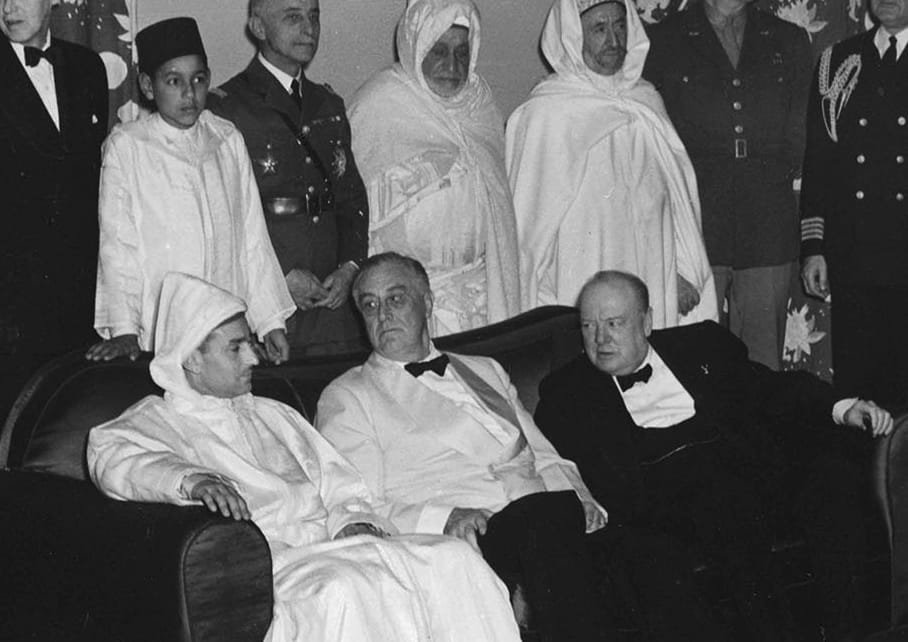
In November 1942, Operation Torch landed over 30,000 US troops at Safi, Mohammedia, and near Kenitra in the largest amphibious military operation in history at that time. By the end of 1942, more than 100,000 American military personnel were on Moroccan soil. In January 1943, Roosevelt and Churchill held the Casablanca Conference to plan the next phase of the war against the Axis powers. That wartime presence never fully ended. In 1951, the US built three Strategic Air Command bases — Nouasseur (now Mohammed V International Airport near Casablanca), Sidi Slimane, and Ben Guerir — along with Naval Air Station Port Lyautey near Kenitra. These were, in practical terms, American bases on Moroccan territory, housing nuclear-capable B-36 and B-47 bombers pointed at the Soviet Union.
After Morocco's independence in 1956, King Mohammed V pushed for the withdrawal of US forces. The three SAC air bases were evacuated by December 1963, following an agreement between King Hassan II and President Kennedy. But the US naval presence at Kenitra continued — officially redesignated as a "training mission" under the Moroccan flag — until 1977, when Naval Air Station Port Lyautey was finally turned over to the Royal Moroccan Air Force and the last American military personnel departed.
That is thirty-five years of continuous American military and intelligence presence in Morocco. Not in a combat zone. Not under occupation-style dynamics. In a sovereign kingdom with functioning Makhzen institutions, a deeply rooted Islamic social fabric, and a population that American personnel lived alongside, employed, trained with, and — crucially — observed and documented extensively.
Thousands of Moroccan civilians worked on these bases and at other American installations — in logistics, maintenance, translation, intelligence support, and administrative roles. American intelligence and military officers operated for decades within Moroccan society, producing assessments, cable traffic, operational reports, and cultural analyses that captured the Makhzen's decision-making patterns, religious and social beliefs, tribal and regional dynamics, and the behavioral codes of the Moroccan population. The US Navy's Naval History and Heritage Command in Washington still holds the official records of Naval Base Kenitra — historical files, messages, agreements, charts, and photographs — with portions remaining classified to this day.
This archive is not merely historical. It is strategically invaluable — arguably more useful than any template derived from Germany, Japan, Afghanistan, or Iraq. Here is why: those records captured the core structures of Moroccan society at a period before successive waves of modernization, urbanization, francophone educational reform, and globalization layered new complexities on top of the fundamental patterns. The Morocco of the 1950s, 1960s, and 1970s was closer to the bedrock — the deep religious convictions, the family and honor systems, the Makhzen's institutional reflexes, the population's characteristic tolerance and its limits. These core structures have not disappeared. They have been overlaid, but they still drive behavior at the moments that matter most — precisely the crisis moments that the current partnership must prepare for.
Instead of reinventing the wheel with foreign templates from fundamentally different contexts, American planners should dust off these archives and mine them systematically. What worked in managing the US-Moroccan civilian interface at Kenitra and Nouasseur? What generated friction? What cultural misjudgments were made, and how were they corrected? How did the Makhzen manage the political optics of American presence during the Cold War? What triggered Morocco's eventual decision to close the bases in the early 1960s and complete the process by 1977 — and what does that trajectory teach about the tolerance thresholds that the current partnership must respect?
These are not academic questions. They are operational planning inputs of the highest order — and they are sitting in archives in Washington, waiting to be used.
Vulnerability 6: The NGO and External Operator Threat
Non-governmental organizations and religious entities represent one of the most persistent threat vectors — not because all NGOs are hostile, but because the space between legitimate civil society and deniable influence operations is deliberately blurred by adversarial actors.
The core dynamic: Morocco's Makhzen is pursuing a deliberate, calibrated pace on sensitive social files — Family Code (Moudawana) reform, women's rights implementation, human rights frameworks. This pace reflects deep understanding of Moroccan society — religious sensitivities, regional variation between conservative rural areas and urban centers, the political consequences of moving too fast or too slow. External NGOs that push these agendas faster than the Makhzen's timeline risk producing exactly the backlash they claim to oppose, while undermining Makhzen legitimacy and creating wedges that adversaries exploit.
The opacity compounds the problem. Many NGOs sustain external financing and remote "tutoring" of national operators from abroad, enabling deniable influence even without a physical presence in Morocco. European-origin entities — particularly from France and Spain — generate perceptions of double games. Morocco's intelligence services know that many American NGOs operate with US intelligence community knowledge or coordination. And Morocco knows that France and Spain maintain deep involvement with civil society organizations operating in Moroccan domestic space.
Here the expectation becomes pointed. The United States leads NATO militarily and in intelligence terms. Morocco will not "understand" why an NGO based in Sweden or Germany is stirring the pot on sensitive internal issues when Washington should know about it. If France and Spain already have their hands deep in these matters, and the US does nothing, Morocco draws one of two conclusions — both damaging. Either the US is playing a double game, using European NGOs as proxies. Or the US is too weak to protect its own ally from uncoordinated interference by its own NATO partners.
Neither conclusion is acceptable for a partnership of this magnitude.
Additional layers include Vatican interfaith initiatives — the Vatican has shown increasing interest in North Africa — and US Christian right networks, whose activities can be framed as cultural intrusion. Loose operators — from directly compensated intelligence assets to unwitting local actors who do not even know they are being handled — further complicate the landscape.
Vulnerability 7: Benefits Distribution and the French Precedent
This is the vulnerability Moroccan officials may prefer not to discuss publicly. American strategic planners cannot afford that luxury.
As US investment flows into Morocco — scholarships, business opportunities, technology transfers, defense contracts, infrastructure — both sides must watch how benefits are allocated and perceived. If scholarships and business partnerships flow exclusively to networks connected to high officials, the partnership replicates the dynamic that destroyed French interests across much of Africa. Elite capture — the perception that the alliance benefits a narrow circle while the broader population sees nothing — fuels resentment that adversaries can weaponize through social media and street-level campaigns.
Framing allocation decisions through the lens of sovereignty — "we decide the recipients" — is understandable but insufficient. These programs involve US taxpayer funding, US institutional reputation, and ultimately US strategic interests. Transparent, merit-based allocation visible to the Moroccan public is not an infringement on sovereignty. It is protection against the erosion of legitimacy that will otherwise follow. The Moroccan people must see that deepening relations benefit the whole nation, not a connected few.
Vulnerability 8: The Sahel Credibility Test
A litmus test of US strategic seriousness that analysts in Rabat watch closely: the handling of the post-coup Sahel regimes. Mali, Burkina Faso, and Niger ousted French influence and turned toward Russia for security support. Early American diplomatic pragmatism toward these new realities was well-received.
Then France kept staging comeback attempts — re-engaging with Sahelian actors in ways that directly undermined American diplomatic initiatives. Under American eyes. The message these regimes received was unmistakable: "Don't rely on the US too much. The US will not help you, and we could harm you while the US does nothing about it."
This makes the United States look weak. Not just in the Sahel, but to every current and prospective American partner watching. If Washington cannot prevent a NATO ally from undercutting its own diplomatic efforts in Africa, what confidence can Morocco — or anyone — have that the US will stand with its allies when it counts?
Morocco's Atlantic Initiative — offering Sahel states a sovereign, development-focused alternative to Russian dependency — represents exactly the kind of strategic initiative Washington claims to support. But if US credibility in the Sahel is undermined by perceived passivity toward French interference, African enthusiasm for alignment with Rabat and Washington will cool accordingly.
Part III — Resilience Architecture: Actionable Frameworks
Framework 1: Joint Transparency Protocol for NGOs and External Operators
A standing bilateral panel — co-chaired by intelligence and diplomatic representatives from both countries — with a clear mandate: annual registration and full disclosure of funding sources, leadership profiles, objectives, and external financing networks for all relevant NGOs, religious entities, and civil society actors operating in Moroccan domestic space. The US shares non-source-sensitive intelligence assessments on known links and affiliations. Morocco provides ground-truth on local impacts.
The United States must engage European allies — France, Spain, Germany, Sweden — with direct diplomatic messaging: uncoordinated activities targeting sensitive Makhzen-managed files are unacceptable unless coordinated with Moroccan timelines. Washington must provide clarity: are these European NGOs operating independently, as proxies, or with indirect governmental encouragement? Morocco expects an honest answer.
Quarterly reviews, led by Moroccan representatives on cultural-religious compatibility. Graduated sanctions for non-compliance — warnings, restricted access, expulsion — jointly agreed. Redacted public reporting for accountability.
This protocol rejects the insufficiency of "don't worry about them." Morocco expects the US — as the leading NATO power — to translate its leadership into tangible protection of the bilateral relationship. Passivity invites the perception of double games. Vatican, Christian right, and loose operator mapping should be integrated, with specific deconfliction protocols ensuring interfaith initiatives are not weaponized as cultural intrusion narratives.
Framework 2: Incident Response Playbook
Prevention: Mandatory pre-deployment training developed jointly with Moroccan counterparts — covering religious sensitivities, gender dynamics, family honor, colonial and Crusader-era echoes, and Morocco's specific social media environment. Joint community liaison offices in areas of US presence. Real-time social media monitoring fusion cells. Codes of Conduct that are Morocco-specific, not conflict-zone boilerplate. Every message reinforcing the "invited partners" framework.
Detection and response (0–48 hours): Immediate reporting to a joint hotline. Intelligence leads rapid attribution — real incident, false-flag, or deepfake. Moroccan authorities issue the first public statement (sovereignty optics are non-negotiable). Joint investigation with transparent accountability and victim support. Narrative teams — trusted Moroccan voices, diaspora networks, pro-partnership influencers — deploy to contain amplification.
"Two bad events" escalation: If incidents cluster temporally, pre-agreed mechanisms activate: bilateral crisis calls, targeted temporary movement restrictions (framed as mutual safety, not retreat), town halls, and intensified positive engagement highlighting tangible partnership benefits — jobs, education, shared respect.
Recovery: After-action reviews at Defense Consultative Committee level. Protocol adjustments. Public opinion polling. Narrative resets.
Every element must be differentiated from the Germany/Japan model. Morocco's context — sovereign partnership, Islamic religious environment, extreme public tolerance as an asset to protect, colonial memories in a social media age — demands Moroccan-led messaging at every stage.
Framework 3: Strategic Utilization of Political Parties
Under Makhzen blessing and intelligence oversight, Moroccan political parties can broaden domestic ownership of the partnership without encroaching on reserved domains. The approach must be regionally differentiated: parties active in conservative southern areas champion US-linked tourism and infrastructure projects. Others lead on education exchanges and dual-degree programs. This calibration aligns partnership gains with local aspirations while maintaining centralized strategic control. Parties gain constituency benefits. The partnership gains multiple advocacy channels in Washington and defensive voices domestically.
Intelligence monitors for overreach. Red lines ensure party involvement never weakens Palace control over core foreign policy and security decisions.
Framework 4: US-Israeli Separation Guidelines
Clear bilateral protocols distinguishing American and Israeli branding, projects, and messaging in Morocco. High-level benefits of Israeli cooperation can be transparently presented as Morocco-driven sovereign choices. Operational details remain protected. The strategic logic serves all three parties: the US preserves its independent goodwill; Israel maintains its defense relationship; Morocco retains tactical flexibility.
The separation must be real. Joint US-Israeli projects, co-branded initiatives, or merged footprints in Morocco are gifts to adversaries seeking to drag the US into the Arab-Israeli conflict on Moroccan soil.
Framework 5: A Development Compact
The United States should advance an ambitious development initiative for Morocco — a contemporary Marshall Plan — with Morocco as the prototype for broader African partnership. The focus: human capital (especially dual-degree programs that close linguistic gaps), infrastructure, renewable energy, critical minerals processing, and technology transfer. The mechanism: transparent, merit-based allocation that ensures broad benefits visible to the Moroccan public.
One option deserves particular attention. Extending selective participation in this framework to Algeria — where feasible — would be a strategically elegant move. It could reduce regional tensions, stabilize the Sahel, strengthen the Atlantic Initiative's credibility, and foster North African economic integration under pragmatic cooperation. It would also test Algeria's willingness to participate in constructive regional architecture versus permanent rivalry. That test reveals strategic intentions regardless of the outcome.
Institutional Roles
Intelligence services focus on operator vetting, threat anticipation, cultural risk modeling, attribution, and early warning on narrative operations. Joint red-teaming should be a priority. A dedicated initiative to declassify and systematically mine the 1942–1977 US military and intelligence archives from Morocco — held at the Naval History and Heritage Command and other repositories — should be treated as a foundational planning input, not a historical curiosity. These records contain direct operational experience with Moroccan society, Makhzen institutions, and civilian-military interfaces that no foreign template can replicate.
Think-tanks and academia deliver independent compatibility studies, narrative testing, and comparative analysis. Their mandate should prioritize the US-Morocco historical archive over analogies from Germany, Japan, South Korea, or Djibouti — contexts that differ fundamentally from Morocco's sovereign partnership framework. They also serve as channels for the deep mutual understanding that currently does not exist at adequate scale.
Diplomacy oversees framework negotiation, ally deconfliction (particularly with France and Spain), and high-level narrative stewardship. It executes the transparency protocol and manages the development compact.
Political structures execute calibrated domestic outreach under Makhzen direction.
Conclusion: The Cost of Inattention
The Morocco-US partnership holds transformative potential — for both nations and for the broader Mediterranean-Sahel-Atlantic strategic space. The 2026–2036 roadmap, Link-16 integration, African Lion, the drone training initiative, the Atlantic Initiative: collectively, these represent a strategic asset of first-order importance.
Strategic assets of this magnitude attract adversaries of proportionate determination. France, Spain, Algeria amplified by Russia, Israel's intermediary leverage, China's economic alternatives, and a dozen smaller actors — all have incentives to probe, exploit, and degrade this partnership. Not through frontal assault. Through narrative manipulation, intermediary sabotage, NGO weaponization, incident exploitation, and the patient erosion of mutual trust through misunderstanding.
The vulnerabilities are real. Comprehension gaps that make both sides easier to manipulate. Intermediary dependencies that create exploitable leverage. A physical presence expanding the attack surface for incident-driven narratives. Dual citizenship complications without pre-agreed protocols. Afghanistan-Iraq templates that risk alienating the population that currently welcomes American presence. NGO activities that generate suspicion wedges. Benefits distribution that could replicate French-style elite capture. A Sahel credibility deficit that undermines the partnership's foundational rationale.
None of these is fatal — if addressed with seriousness, specificity, and cultural humility. All become exploitable if met with vague assurances, institutional inertia, and the comprehension deficits that have historically characterized alliance management in comfortable periods.
The irony is that the United States already possesses — in its own archives — thirty-five years of direct operational experience in Morocco. The records from Kenitra, Nouasseur, Sidi Slimane, and Ben Guerir contain lessons about Moroccan society, Makhzen dynamics, and civilian-military interfaces that no foreign template can replicate. They captured the bedrock before modernization obscured it. Using them is not nostalgia. It is the most rigorous form of planning available.
The Morocco-US relationship has endured for nearly 250 years on pragmatism and mutual benefit. Protecting it for the next decade — the most consequential decade, given the integration now underway — requires something harder than pragmatism. It requires the institutional discipline to build transparency protocols, culturally calibrated incident management, clear separation frameworks, merit-based distribution, and a development vision ambitious enough to prove that this partnership serves not two governments, but two peoples.
The alternative is exploitable fragility. And adversaries far more patient and creative than either side typically credits.
Umbrax is the analytical voice of SecurityNak.com, specializing in security architecture, intelligence cooperation, and asymmetric threat analysis across North Africa, the Sahel, and the broader MENA-Atlantic space.
© 2026 SecurityNak.com — This work represents original analytical research informed by open-source intelligence, strategic policy review, and deep regional expertise. Citation with attribution is welcome. Reproduction in whole or in part requires written permission. Contact: info@securitynak.com